







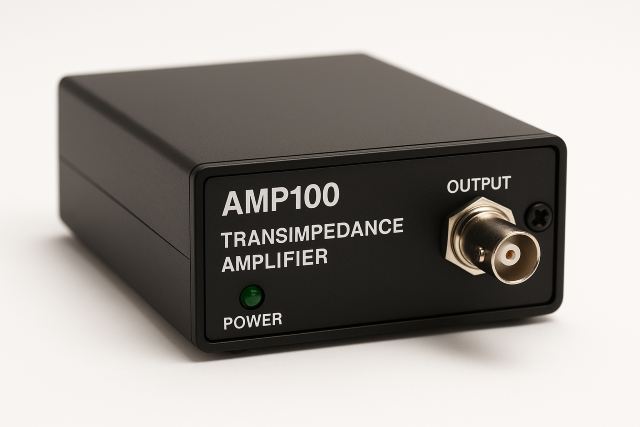
The AMP100 Transimpedance Amplifier has become a go-to component in precision signal detection, especially in photodiode, sensor, and low-current applications. Known for its high gain stability, low noise, and wide bandwidth, the AMP100 is designed to convert weak current signals into measurable voltages with exceptional accuracy.
In this complete guide, we’ll explore everything about the AMP100 Transimpedance Amplifier — from its operating principle to design insights, specifications, and industry applications. Whether you’re an engineer, researcher, or electronics hobbyist, this article will help you understand how the AMP100 enhances modern analog signal processing.
What Is the AMP100 Transimpedance Amplifier?
A transimpedance amplifier (TIA) is an electronic circuit that converts current input into proportional voltage output. The AMP100 Transimpedance Amplifier is a specialized TIA module designed for precision measurement systems where low-noise performance and fast response are crucial.
Typically, it’s used with photodiodes, avalanche photodiodes (APDs), or sensors that output small current signals. The AMP100 provides high transimpedance gain, ensuring even faint signals are amplified without distortion or delay.
In simpler terms:
The AMP100 takes a small current from a sensor and turns it into a clean, readable voltage for further processing or measurement.
Working Principle of the AMP100 Transimpedance Amplifier
At its core, the AMP100 Transimpedance Amplifier operates on Ohm’s law, where current through a resistor produces a proportional voltage. However, instead of a simple resistor, the AMP100 integrates an operational amplifier (op-amp) with a feedback resistor to achieve high sensitivity and linear response.
Basic Function
- Input: Very low current (picoamps to microamps)
- Output: Scaled voltage proportional to the input current
- Feedback Loop: Controls the gain and stability of the amplifier
Core Equation
Vout=−Iin×RfV_{out} = -I_{in} \times R_fVout=−Iin×Rf
Where:
- VoutV_{out}Vout = Output voltage
- IinI_{in}Iin = Input current
- RfR_fRf = Feedback resistor value
The negative sign indicates phase inversion, a normal property of inverting amplifier configurations.
Key Features of the AMP100 Transimpedance Amplifier
Here’s what makes the AMP100 stand out among its peers:
| Feature | Description |
|---|---|
| High Transimpedance Gain | Provides gain values from 10⁴ to 10⁸ V/A, ideal for weak current detection |
| Low Noise Density | Ensures clean signal amplification without interference |
| Wide Bandwidth | Suitable for high-speed photodiode and sensor applications |
| Temperature Stability | Maintains performance consistency across varying environments |
| Compact Form Factor | Easily integrated into optical, medical, and scientific instruments |
| Power Efficiency | Consumes minimal current, enhancing system longevity |
Pro Tip: The AMP100 is often paired with shielded cables and grounded enclosures to reduce external noise pickup.
Technical Specifications (Typical)
| Parameter | Value |
|---|---|
| Transimpedance Gain (R<sub>f</sub>) | 10⁶ V/A (adjustable) |
| Bandwidth (-3 dB) | 1 MHz (depends on feedback network) |
| Input Noise Current Density | < 2 fA/√Hz |
| Input Bias Current | < 1 pA |
| Supply Voltage | ±12 V to ±15 V DC |
| Output Voltage Swing | ±10 V |
| Operating Temperature Range | -40°C to +85°C |
| Input Connector Type | BNC / SMA (varies by manufacturer) |
These specs can vary slightly depending on the specific AMP100 model or manufacturer, but they provide a strong baseline for design planning.
Circuit Design of the AMP100 Transimpedance Amplifier
Basic Circuit Diagram
A typical AMP100 configuration includes:
- An operational amplifier (core of the TIA)
- A feedback resistor (R<sub>f</sub>)
- A feedback capacitor (C<sub>f</sub>) to prevent oscillations
- Input terminal for sensor current
- Output terminal for voltage signal
Stability Considerations
High-gain TIAs can be prone to oscillation. The feedback capacitor is crucial to maintain phase margin and reduce ringing. Proper PCB layout, grounding, and shielding are essential for maintaining stability in high-frequency designs.
Design Tip:
Use a ground plane and keep the input trace as short as possible to minimize parasitic capacitance.
AMP100 Transimpedance Amplifier Applications
The AMP100 finds use in a wide variety of industries due to its precision and versatility.
1. Optical and Photodiode Detection
- Used in laser measurement, optical power meters, and LIDAR systems.
- Converts tiny photodiode currents into measurable voltages.
- Ensures linear and noise-free conversion, even at low light levels.
2. Medical and Biochemical Instrumentation
- Supports fluorescence detection and spectrophotometry.
- Critical for high-sensitivity biosensors where low current signals dominate.
3. Scientific Research
- Utilized in laboratory photodetectors, radiation sensors, and ionization chambers.
- Ensures reliable data in low-signal experiments.
4. Industrial Automation
- Integrated in precision sensors, leak detectors, and optical encoders.
- Enhances feedback accuracy and measurement repeatability.
5. Communication Systems
- Used in fiber optic receivers and lightwave communication equipment.
- Provides fast response and low distortion in high-speed data transfer.
Advantages of Using the AMP100 Transimpedance Amplifier
| Advantage | Description |
|---|---|
| High Sensitivity | Amplifies extremely low currents with minimal noise. |
| Flexibility | Adjustable gain settings for various applications. |
| Compact & Reliable | Small footprint suitable for embedded systems. |
| Accuracy | Low offset voltage ensures linear and precise output. |
| Compatibility | Works with most standard photodiode interfaces. |
Limitations and Design Challenges
No amplifier is perfect — and the AMP100 is no exception. Engineers should be mindful of the following limitations:
- Limited Dynamic Range: High-gain settings can saturate quickly under strong signal conditions.
- Thermal Drift: Temperature variations can slightly affect gain accuracy.
- Noise Sensitivity: Requires careful PCB design to avoid coupling noise from other components.
- Cost Factor: Precision components increase the overall cost of the system.
Solution:
Implement proper heat management and shielded cabling to maintain optimal performance.
AMP100 Transimpedance Amplifier vs. Other Models
| Feature | AMP100 | OPA380 (Texas Instruments) | AD8605 (Analog Devices) |
|---|---|---|---|
| Transimpedance Gain | High (up to 10⁸ V/A) | Moderate | Moderate |
| Noise Level | Extremely Low | Low | Moderate |
| Bandwidth | Wide (up to 1 MHz) | Narrower | Medium |
| Application Focus | Photodiode, Research | Sensor Systems | General Purpose |
| Cost | Mid to High | Low | Moderate |
Conclusion: The AMP100 is ideal when your design demands ultra-sensitive, high-precision current-to-voltage conversion.
How to Choose the Right Transimpedance Amplifier
When selecting a TIA like the AMP100, consider the following:
- Input Current Range – Estimate your sensor’s output current to avoid amplifier saturation.
- Noise Requirement – Choose low-noise amplifiers for high-accuracy applications.
- Bandwidth Needs – Match amplifier speed to your signal frequency.
- Power Supply Compatibility – Ensure your circuit supports the required ± voltage rails.
- Environmental Conditions – Select components rated for your operating temperature and humidity.
Installation and Calibration Tips
- Shielded Cabling: Use coaxial or twisted-pair cables to minimize EMI.
- Grounding: Connect all grounds at a single point to avoid loops.
- Calibration: Use known input currents and adjust feedback resistor values to verify gain accuracy.
- Temperature Testing: Validate performance under different conditions to ensure reliability.
Common FAQs About the AMP100 Transimpedance Amplifier
Q1. What makes the AMP100 Transimpedance Amplifier unique?
Its combination of low noise, high gain, and wide bandwidth makes it ideal for ultra-low current detection in photodiode systems.
Q2. Can I use the AMP100 with a single power supply?
While some versions support single-supply operation, bipolar supply (±12V or ±15V) ensures better linearity and output swing.
Q3. What type of feedback resistor is used in the AMP100?
Typically, high-precision metal film resistors are used to ensure stability and low temperature coefficient.
Q4. How can I reduce noise in my AMP100 circuit?
Shorten input leads, use shielded enclosures, and add proper decoupling capacitors near the power pins.
Real-World Example — Optical Sensor Integration
Consider a laser power measurement system using a silicon photodiode. The photodiode produces a current of 100 nA proportional to light intensity. Using the AMP100 Transimpedance Amplifier with a feedback resistor of 10 MΩ: Vout=−(100nA×10MΩ)=−1VV_{out} = – (100nA \times 10MΩ) = -1VVout=−(100nA×10MΩ)=−1V
This clear voltage output can then be processed by an ADC for digital display. The AMP100 ensures the measurement is fast, stable, and linear even under fluctuating light conditions.
Future Trends in Transimpedance Amplifier Design
As electronics move toward higher sensitivity and miniaturization, amplifiers like the AMP100 will continue to evolve.
Emerging trends include:
- Integrated TIAs with built-in ADCs
- AI-enhanced noise compensation circuits
- Lower power consumption for IoT sensor nodes
- Miniaturized modules for portable optical instruments
Conclusion
The AMP100 Transimpedance Amplifier stands out as a benchmark in precision signal amplification. Its superior gain, noise performance, and flexibility make it invaluable in fields like photonics, medical diagnostics, and scientific instrumentation.
From converting nanoamp currents into stable voltage signals to enabling high-speed optical measurements, the AMP100 embodies engineering precision at its best.