







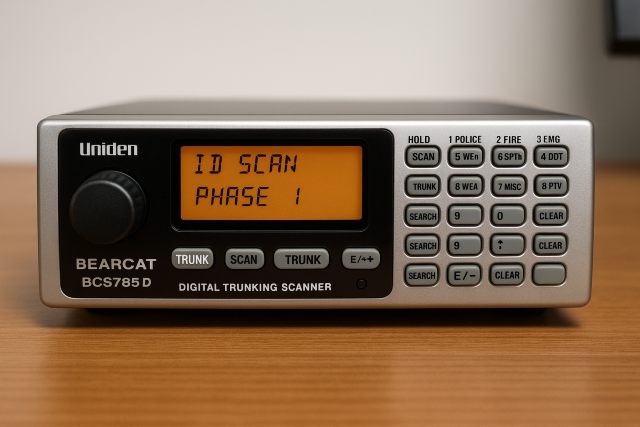
If you’re asking “Bearcat BCS785D is it Phase 1 or 2?”, you’re not alone. Thousands of scanner enthusiasts and public-safety hobbyists still own the Uniden Bearcat BCS785D, one of the most iconic digital scanners of its era.
However, as technology evolves, radio systems have transitioned from P25 Phase 1 (FDMA) to Phase 2 (TDMA). This shift has left many wondering if their older scanners are still usable — or if it’s time to upgrade.
In this comprehensive guide, we’ll break down everything you need to know: what Phase 1 and Phase 2 mean, which one the BCS785D supports, how to identify your local system type, and what options you have in 2025 and beyond.
Overview of the Bearcat BCS785D
The Uniden Bearcat BCS785D is a base/mobile digital trunking scanner designed for public-safety monitoring, introduced in the early 2000s. It was one of the first scanners to support P25 digital systems, making it revolutionary in its day.
Technical Specifications
| Feature | Description |
|---|---|
| Model | Uniden Bearcat BCS785D |
| Type | Base/Mobile Digital Trunking Scanner |
| Channels | 500 |
| Bands | VHF, UHF, 800 MHz |
| Digital Support | P25 Phase 1 (requires BCi25D card) |
| Trunking Systems | Motorola Type I/II, EDACS, LTR |
| Display | Backlit LCD |
| Connectivity | RS-232 port for computer programming |
| Audio Output | 8Ω, 3.5mm jack |
When paired with the optional BCi25D digital card, the scanner could decode Project 25 Phase 1 signals — an incredible leap forward for scanner technology at the time. However, the hardware’s architecture was limited to FDMA (Frequency Division Multiple Access), meaning no TDMA (Phase 2) support.
Phase 1 vs. Phase 2: What’s the Real Difference?
Before diving deeper, it’s important to understand the technical differences between Phase 1 and Phase 2 systems — since this is the main reason your scanner may or may not work with certain frequencies.
| Feature | Phase 1 (FDMA) | Phase 2 (TDMA) |
|---|---|---|
| Transmission Type | FDMA (one voice per frequency) | TDMA (two voices per frequency) |
| Bandwidth Efficiency | Lower | Higher (twice the capacity) |
| Voice Quality | Good | Equal or slightly better |
| Encryption | Optional | Optional (but more common) |
| Compatibility | Works with older scanners | Requires Phase 2-capable scanners |
| Example Systems | Legacy P25, Motorola Type II | Newer APCO-25 systems |
In simple terms:
- Phase 1 sends one conversation per frequency.
- Phase 2 sends two conversations per frequency — more efficient, but needs updated hardware.
Because the Bearcat BCS785D was built during the Phase 1 era, it doesn’t have the processor or decoder needed for TDMA (Phase 2) transmissions.
So, Is the Bearcat BCS785D Phase 1 or Phase 2?
Here’s the short, direct answer:
The Bearcat BCS785D is a Phase 1 digital scanner only.
It can decode P25 Phase 1 (FDMA) digital signals if equipped with the BCi25D card, but it cannot decode Phase 2 (TDMA) systems.
Supported Systems:
- Analog Conventional (FM/AM)
- Motorola Type I/II Trunking
- EDACS Standard / Narrowband
- LTR Trunking
- P25 Phase 1 (with digital card)
Unsupported Systems:
- P25 Phase 2 (TDMA)
- NXDN
- DMR/MotoTRBO
- Encryption-enabled systems
In modern terms, this means your BCS785D is compatible with older analog and P25 Phase 1 systems — but will remain silent on Phase 2-only systems.
Why the BCS785D Can’t Decode Phase 2
Phase 2 uses Time Division Multiple Access (TDMA) to split a single frequency into time slots. This requires more complex signal processing and decoding — something the BCS785D’s internal hardware can’t perform.
To make the BCS785D Phase 2-capable, Uniden would need to:
- Add a new digital decoding chip,
- Upgrade the firmware, and
- Modify the DSP (Digital Signal Processor) architecture.
Because these parts are physically integrated into the device, no firmware or external module can enable Phase 2 on this model.
Checking Whether Your Area Uses Phase 2 Systems
Before deciding whether to retire or keep your scanner, check whether your local radio systems still operate on Phase 1.
Step-by-Step Guide:
- Visit RadioReference.com
- Enter your state and county in the search bar.
- Look under System Type for “P25 Phase I” or “P25 Phase II.”
- Look at System Talkgroups
- If you see “Mode: D” — it’s Phase 1.
- If you see “Mode: T” — it’s Phase 2 (TDMA).
- Check Local Forums or Facebook Groups
- Scanner hobbyists often post real-time updates about system migrations.
- Use a Frequency Test
- Tune into an old frequency.
- If it’s silent or only emits a “buzzing” sound, it’s likely gone Phase 2 or encrypted.
Example: How Phase 2 Migration Impacts Users
Let’s say you live in Dallas County, Texas. For years, local police and fire operated on Phase 1 systems compatible with your BCS785D.
In 2023, they upgraded to P25 Phase 2 to increase efficiency and support encrypted talkgroups. Overnight, your scanner stopped picking up those communications.
That’s not a malfunction — it’s a compatibility issue. The system changed, not your scanner.
Can You Upgrade the Bearcat BCS785D to Phase 2?
Sadly, no.
There’s no hardware, firmware, or software update that can make the Bearcat BCS785D decode TDMA signals.
Even adding a BCi25D digital card only enables Phase 1 support. Once your area fully transitions to Phase 2, your scanner will only receive analog or legacy digital transmissions.
Why Upgrading Is Necessary
If you want to monitor modern law enforcement, fire, or EMS systems, you’ll need a Phase 2-compatible scanner. These newer models decode both FDMA and TDMA signals, ensuring complete coverage.
Best Modern Replacements for the BCS785D
If you’re ready to upgrade, consider one of these Phase 2-ready scanners:
| Model | Type | Phase 1 | Phase 2 | Features |
|---|---|---|---|---|
| Uniden BCD436HP | Portable | ✅ | ✅ | Easy setup, GPS support |
| Uniden BCD536HP | Base/Mobile | ✅ | ✅ | Wi-Fi & PC control |
| Uniden SDS100 | Portable | ✅ | ✅ | Best for simulcast reception |
| Uniden SDS200 | Base/Mobile | ✅ | ✅ | Top-tier display & performance |
| Whistler TRX-1 | Portable | ✅ | ✅ | Includes DMR/NXDN |
| Whistler TRX-2 | Base/Mobile | ✅ | ✅ | Strong mobile reception |
These scanners are future-proof, support digital upgrades, and have database-driven scanning, making setup easy for beginners and experts alike.
Keeping Your BCS785D Useful
Even though it’s not Phase 2-compatible, your BCS785D isn’t useless. You can still use it for:
- Analog VHF/UHF channels (aviation, marine, railroads)
- Weather frequencies (NOAA)
- Ham radio monitoring
- Amateur trunking systems
- Backup scanning for non-digital systems
You can even connect it to a computer via FreeSCAN or ProScan for logging, recording, and remote control — breathing new life into your legacy device.
Troubleshooting Common Issues
1. Hearing Only Static or Silence
Likely cause: Your area switched to Phase 2 or encrypted systems.
2. “DIGITAL” Doesn’t Appear on Screen
You may not have installed the BCi25D digital card, which is required for P25 decoding.
3. Frequency Appears Active, But No Audio
This often means it’s a Phase 2 TDMA signal — your scanner can’t decode it.
4. Programming Errors
Use software like FreeSCAN or ProScan to double-check frequencies, trunking tables, and control channels.
FAQs About the Bearcat BCS785D
Q1. Does the Bearcat BCS785D work with P25 Phase 2?
No. It only works with P25 Phase 1 (FDMA). Phase 2 (TDMA) is not supported.
Q2. What’s the difference between the BCS785D and BCD996P2?
The BCD996P2 supports both Phase 1 and Phase 2, while the BCS785D supports only Phase 1.
Q3. Can I still use the BCS785D in 2025?
Yes — as long as you monitor analog or Phase 1 systems. It’s great for non-trunked communications.
Q4. How do I know if a frequency is Phase 1?
Check on RadioReference.com. Phase 1 channels are marked with “Mode: D”, while Phase 2 ones are marked “Mode: T.”
Q5. Can I add a digital upgrade card to make it Phase 2?
No, the BCi25D card only supports Phase 1. No upgrade exists for Phase 2.
Expert Tips: Getting the Most from Legacy Scanners
- Monitor public utilities or aviation bands: These often remain analog.
- Use the scanner for educational purposes: Great for learning trunking systems.
- Pair it with software logging tools: Analyze signal strength and control channels.
- Scan amateur repeaters: Many ham operators use analog VHF/UHF systems your BCS785D can still track.
Conclusion: Should You Keep or Upgrade?
To sum it up, the Bearcat BCS785D is a P25 Phase 1-only scanner. It was a milestone device in digital radio scanning, but as more regions transition to P25 Phase 2, its relevance for public-safety monitoring is declining.
However, don’t discard it yet. It’s still valuable for:
- Analog channels
- Weather monitoring
- Aviation frequencies
- Ham and emergency backup scanning
If your area has gone Phase 2, upgrading to a Uniden BCD436HP, SDS100, or BCD996P2 will ensure you don’t miss a beat.